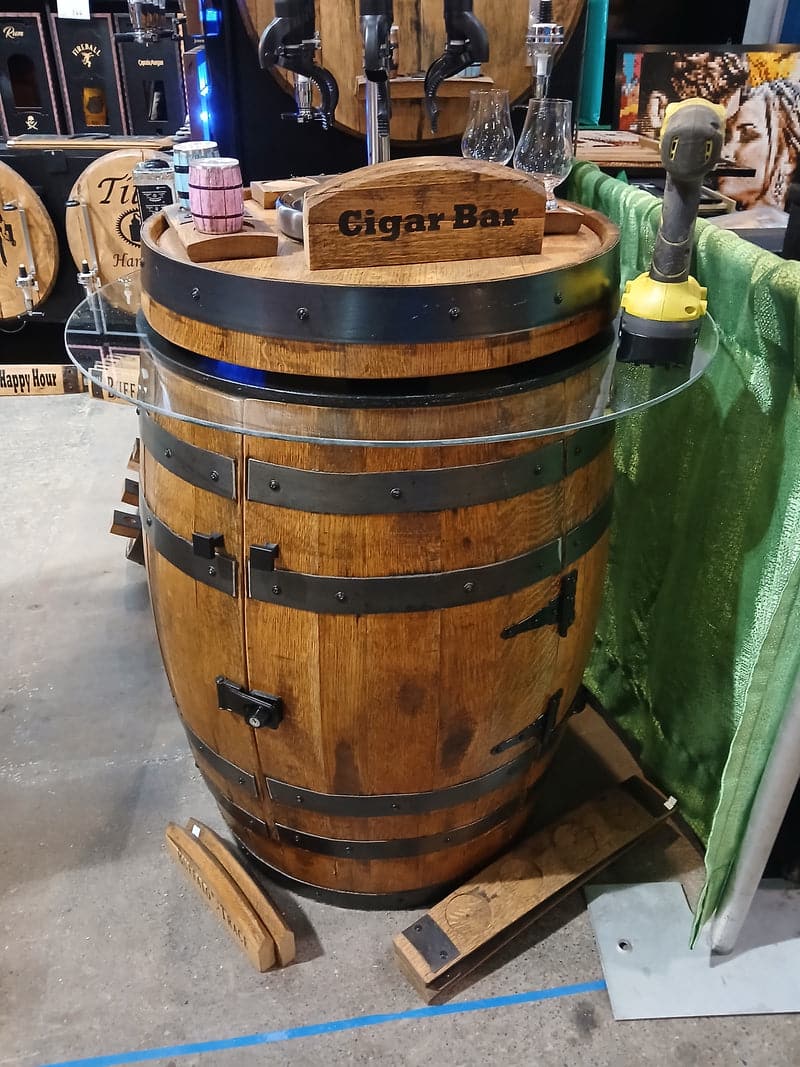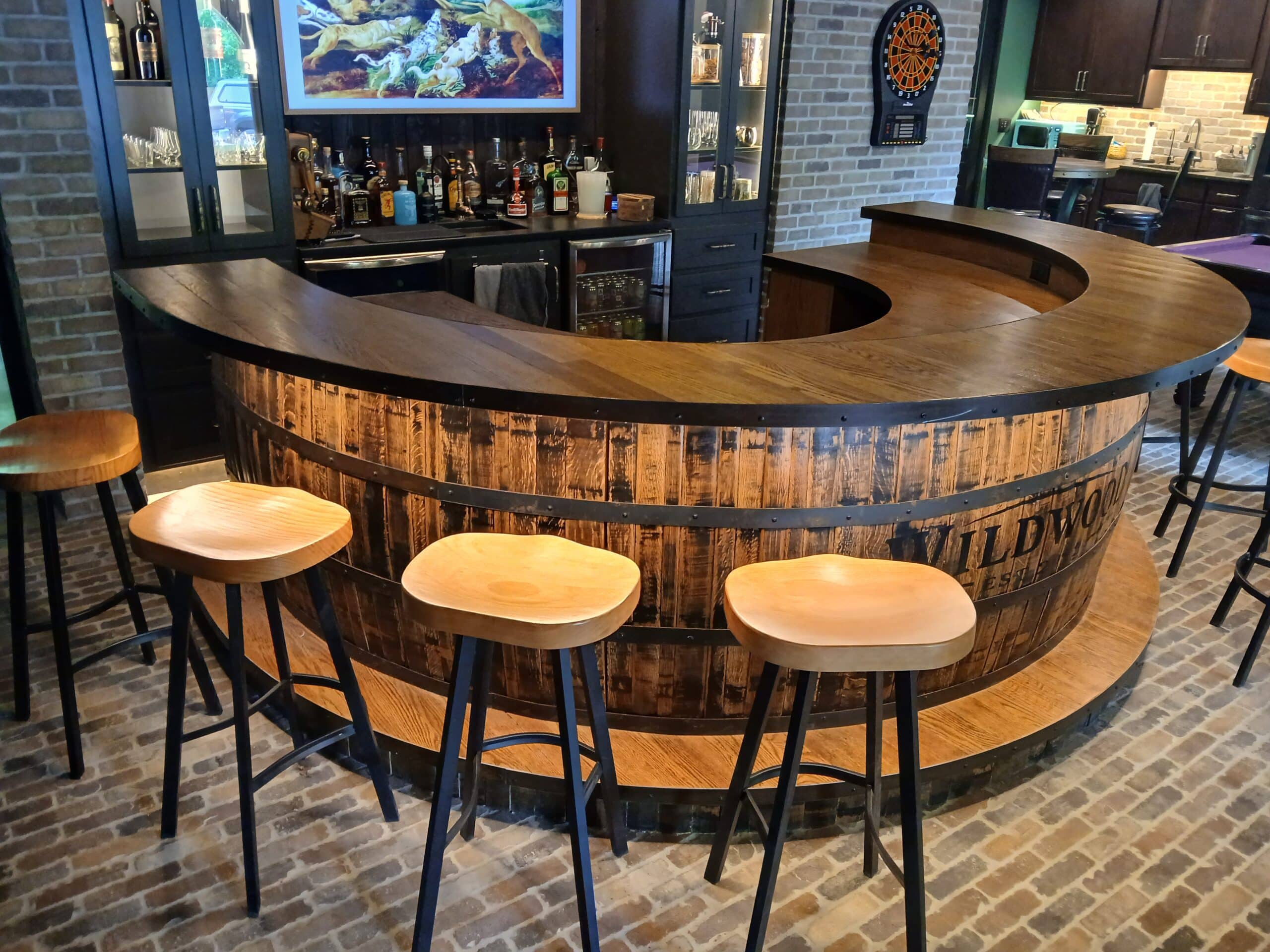

Every reclaimed whiskey barrel has already lived a life before it reaches your wall.
That’s not marketing copy. It’s physics. Bourbon sits inside white oak barrels for years — sometimes a decade — pulling color and flavor from the charred wood. The barrel does its job. Then the distillery is done with it.
Most barrels at that point become firewood. A few become planters. A very small number end up in a workshop in Rapid City, South Dakota, where a former shop teacher turns them into something else entirely.
This is where whiskey barrel decor stops being a Pinterest trend and starts being something you want on your wall for the next twenty years.
What actually happens to a barrel after the whiskey is gone?
The barrel gets broken down. The steel bands come off. The staves — those curved wooden planks that form the barrel — get separated, cleaned, and inspected. Some have burn marks from the original charring process. Some have wine-colored stains from years of bourbon soaking into the grain. Every stave is different.
This is where mass-produced decor and handcrafted pieces diverge. A factory takes wood and makes it uniform. A craftsman looks at each stave and figures out what it wants to be.
The dark, heavily charred staves become the backdrop for an American flag liquor dispenser — the natural char giving the flag depth that paint can’t replicate. The lighter, honey-colored staves might become a lazy susan where the grain pattern is the star of the show. The staves with barrel-maker’s marks or distillery stamps become the centerpiece — the part of the piece you point to when someone asks about it.
Why does any of this matter for your home bar?
Because the alternative is buying bar decor from a big-box store. And here’s what you get when you go that route: something made in a factory overseas, from materials that were never near a distillery, stamped out by the thousand, sold to the same guy in Edina as the guy in Austin.
Your bar ends up looking like everyone else’s bar. Not because you have bad taste. Because you were never given a better option.
Whiskey barrel decor changes that math. Your wall-mounted liquor dispenser has grain patterns that formed over a decade inside a Kentucky rickhouse. The char marks are from actual flame, not brown paint. The imperfections — the nail holes, the saw marks, the rough edges — those are the story. Mass-produced pieces hide their origins. Handcrafted barrel pieces put them front and center.
What kinds of whiskey barrel decor actually exist?
The short list: liquor dispensers, lazy susans, bar lights, whiskey display boxes, custom engraved pieces.
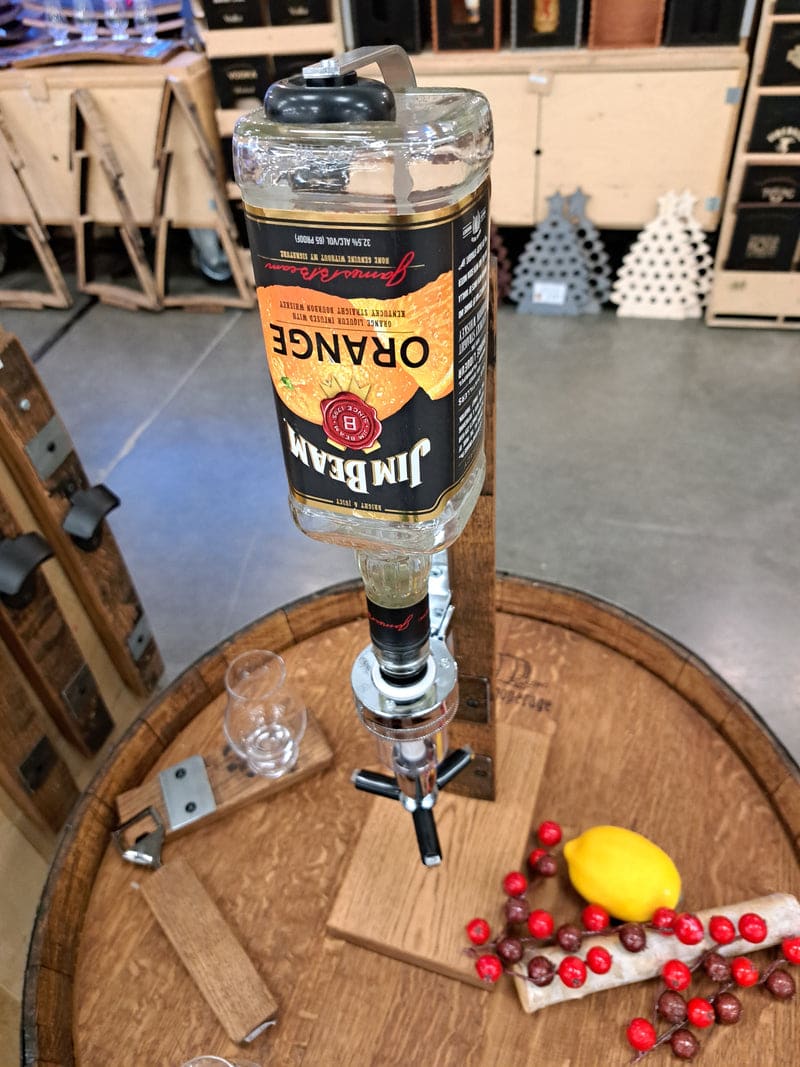
The liquor dispenser is the flagship. A barrel stave or barrel top mounted to a wall bracket, fitted with a pour spout, holding a bottle of bourbon at the perfect angle. It’s functional — you literally pour drinks from it — and it’s the first thing anyone notices when they walk into your bar.
The lazy susan is built from a full barrel top — the circular face of the barrel. Sanded smooth, mounted on a spinning base, perfect for a centerpiece on a bar or dining table. Spin it to pass the whiskey. Spin it to pass the appetizers. Either way, it’s doing more work than any other piece of decor in the room.
The bar lights take a single barrel stave and wrap it in warm LED rope lighting. Wall-mounted. Plugged in. Instant ambiance. If your bar has a dark corner that needs something, this is it.
The whiskey display boxes are the sleeper hit. Tall enough for a 750ml bottle, comes with two engraved shot glasses. It’s a display piece, a storage piece, and a gift piece all at once.
Does reclaimed wood actually hold up?
White oak — the wood used for bourbon barrels — is one of the hardest, most durable hardwoods in North America. It’s the reason distilleries trust it to hold 53 gallons of liquid for a decade without leaking. It doesn’t warp easily. It doesn’t rot. It was literally selected for this job hundreds of years ago, and it’s still the standard.
When that barrel gets repurposed into a wall-mounted liquor dispenser, the wood is already decades old. It’s done moving. It’s stable. It’ll outlast whatever wall it’s mounted on.
And unlike a factory piece that arrives pristine and slowly degrades, reclaimed barrel wood actually looks better over time. The oils from your hands darken the edges. The sunlight bleaches the high spots. The piece settles into your space like it’s always been there.
What makes a piece feel personal?
The engraving. Customization is what turns “nice bar decor” into “this is mine.” A family name. A wedding date. A favorite distillery’s logo. A phrase that means something to the people who will see it every day.
Custom engraving is standard on almost everything Midwest Custom Gifts makes. You pick the piece, you tell them what to put on it, they burn it into the wood. The engraving doesn’t peel, fade, or rub off. It’s in the grain.
For Minnesota home bars in particular, this matters. Minnesota basements are where people actually live. The bar isn’t a showpiece — it’s where you watch the Vikings lose, where the neighbor stops by unannounced, where holiday parties migrate after dinner. The decor should feel like it belongs to your family, your friend group, your space. Not a catalog spread.
Is this the kind of thing you can actually afford?
Handcrafted doesn’t have to mean unaffordable. A barrel stave rope light starts around $120. A tabletop liquor dispenser is in the mid-range. The full-size American flag dispensers are the premium pieces — the kind of thing you save up for and then show off for twenty years.
Compare that to a “designer” bar accessory from a furniture chain. Similar price. Zero story. Mass-produced. Replaceable.
The barrel piece costs about the same and does something the factory piece can’t: it starts a conversation. “Where did you get that?” is a question you will answer a hundred times. “Where did you get that from HomeGoods?” is a question nobody has ever asked.
Browse our full collection of whiskey barrel decor or reach out about a custom piece for your space. Every barrel has a story. We just help it tell yours.
Handcrafted in Rapid City, SD, from genuine reclaimed bourbon and whiskey barrels. Each piece is unique — grain patterns, char marks, and coloring vary. That’s the point.